- Moderator
- #41
http://www.centreforaviation.com/an...itioning-as-a-national-uk-gateway-point-74418
Birmingham Airport repositioning as a national UK gateway point
CAPA > Aviation Analysis > Birmingham Airport repositioning as a national UK gateway point
23rd May, 2012
In the 1980s and 1990s there was one regional airport in Europe that was notably and successfully aggressive in its attempts to convince government of the value of this genus – Manchester. Since then, Munich has taken the baton, with even better results. Now attention swings back to the UK and to Birmingham Airport, which is going a step further, by attempting to persuade government that it should be the extra capacity provider for the southern part of Britain, rather than one or more of the London airports, which have been told that they cannot have any more runway space. CAPA visited Birmingham Airport to discover what it takes for a mid-ranking (8.6 million passengers in 2011) European airport to assume such a position of responsibility within a national air transport framework that hosts over 220 million passengers per annum through its 40 largest airports.
...there is boundless enthusiasm and ambition amongst the management...
Right now, and the airport management acknowledges the fact straight away, Birmingham is not actually growing. Traffic growth in the first three months of 2012 was -4.0%; -0.8% and +1.6% respectively while competitors like London Heathrow, Luton, East Midlands, Bristol and Manchester all grew more robustly, though Birmingham’s growth level is about average for the UK. But there is boundless enthusiasm and ambition amongst the management, which is convinced of the potential of the airport as long as there is a level playing field offered from within the corridors of power at Westminster.
The ambition emanates from CEO Paul Kehoe, originally with BAe Systems and quickly moving into the CEO role at London Luton and Bristol airports before taking up the current brief in Oct-2008; also John Morris, the Head of Government and Industry Affairs, who originally joined the airport to pave with the way for the introduction of high speed rail (HS2), from which Birmingham stands to benefit enormously.
Olympic sized ambitions
The degree of ambition is perhaps emphasised by the fact that Birmingham was the first UK airport to display the Olympic Games rings, for which approval has to be sought through a gruelling licensing procedure.
The airport’s immediate catchment area is estimated as comprising approximately 10 million people. It is centred on Birmingham and its city-region conurbation, known as the West Midlands, but also extends to overlap neighbouring airports such as East Midlands. The catchment area is constrained to the south by Heathrow (and to a lesser degree by Stansted and Luton), to the north by Manchester, and a little to the southwest by Bristol. There is a large swathe of ‘Middle England’ – the relatively wealthy parts of the counties to the north and west of London, and which come right up to the airport’s boundary line, which forms the battleground where Birmingham is constantly employed trying to win hearts and minds.
At the same time John Morris admits that the immediate catchment area, the city and neighbouring boroughs, have not had the best of times since the recession set in. There have been 30 years of industrial decline even before the present recession and Birmingham has not been as quick to reinvent itself as have some of its city-region peers, remaining overly reliant on heavy engineering, motor vehicle and metal industries in general; businesses that have not exactly been at the top of the UK government’s priority list. This goes a long way to explain the sluggish growth now.
To counter these adverse influences the management has become both inventive and loquacious...
To counter these adverse influences the management has become both inventive and loquacious. It is an ardent supporter of the HS2 project that will ultimately connect London, Birmingham, Manchester and Leeds. There is already a rail station on site, shared with the National Exhibition Centre, with regular London trains and with a fast light rail connection straight into the airport terminal called SkyRail. But HS2 would connect Birmingham to London in less than one hour and John Morris is convinced that it would attract at least as many southern England passengers up to Birmingham as the airport would lose to Heathrow. Mr Morris is also an advocate of increasing the speed limit on the nearby M6 toll road (the only one in the country but hopelessly underutilised and loss-making), whilst also reducing charges, thus making road access from the north much quicker and convenient.
There are many niches that Birmingham can fill presently. For example the city itself has a large Afro-Caribbean population and both the West and East Midlands are host to many immigrants from South Asia; especially India. There have been Indian air services in the past at Birmingham and they are actively being sought out again.
On the industrial front here are new biotech industry clusters close by including a leading developer of fuel cells. High quality manufacturing is evident in places like the Land Rover factory in Solihull, which is visible from the airport’s main office, Diamond House, which is aptly named as Birmingham is a major centre for the jewellery trade, rivalling London’s Hatton garden.
Widening catchment area
Further afield, there is evidence that marketing campaigns in and around cities like Oxford, the UK heart of academia, and Milton Keynes, a fast growing new town between Birmingham and London, have had the effect of drawing many new passengers into the airport and away from Heathrow, whose many terminals (Birmingham now has just one since two were joined together) are perceived as being considerably less passenger-friendly.
Even so, there remains an imbalance, with as many as three million passengers a year being lost to Heathrow, which can be accessed particularly quickly from areas to the south of Birmingham Airport along the M40 motorway. And while disposable income is absent amongst so many of the local population, ‘propensity to travel’ – which is highest in the southeast and northwest of England – remains relatively low.
So it is clear that Birmingham needs a jaw dropping proposal if it is to convince government it can fulfil a role as a national gateway point of entry. In fact, under the present management, it has two.
Taking pressure off London for the benefit of London
The first is that it should be considered an additional national hub airport in addition to London, so that it can take some of the strain away from the intense pressures on the airports and ATM systems in the southeast of England, to the benefit of that region. Some of this was covered previously in a previous CAPA article. There is anecdotal evidence that (a) the government is starting to listen to alternative proposals to that of merely adding more runways in the southeast and (b) it is even starting to tire of the insistence by the ‘old guard’ that these measures are the only ones that can ensure the UK retains its position as a leading European air transport hub.
The second proposal, which is still evolving in the mind of John Morris, is that the UK should adopt the German model, which spreads air traffic far more evenly around the country, through hubs in Frankfurt, Munich, Dusseldorf, Berlin (more so when the new airport there actually opens) and Hamburg, supported by the national carrier and its subsidiaries, and that goes hand-in-hand with the wealth redistribution that the UK government (supposedly) craves.
Mr Morris perceives three main alternative air hubs in England beyond London (Scotland should be considered a separate case until its independence claim is settled and Wales does not have the population to support one). They correspond exactly to the line of the HS2 rail project – Birmingham, Manchester, and Leeds and take a ‘Y’ formation north of London. (See map below, red lines).
Logical, captain
His rationale is replete with logic. Linking key rail and air hubs provides for all options for travel involving any of the four main centres of population in England, and the slightly skewed triangle that is formed between Birmingham, Manchester and Leeds, with respect to other important cities like Newcastle and Bristol, was the source of just about everything of importance that was invented and manufactured during the period in the 19thand early 20thcenturies when Britain was the World Superpower. Even with population decline within the triangle, 50% of the 62 million UK inhabitants are within one hour’s journey time of one of these three points.
With the City of London falling foul of European regulation and held in low esteem by just about everyone who does not work in it, a refocusing of the economy on high quality manufacturing in this triangle, supported by world class transport infrastructure, might be exactly the boost the country needs. One suspects it is a prospect that will resonate in at least some parts of the coalition government, and certainly with the Labour Party, which, remarkably, is undergoing something of a renaissance right now.
Global City
Such a proposal is not as ‘out of the box’ as it might at first appear to be.
Indeed, John Morris perceives this triangle would aid the creation of a new ‘global city’ based on the renaissance of old but still valuable skills, with travel times between the three main hubs being roughly equivalent to a journey across London on the Underground. Such a proposal is not as ‘out of the box’ as it might at first appear to be. Under the previous (Labour) administration, Deputy Prime Minister Prescott (a proponent of integrated transport policies and a rail aficionado, as it happens) enthusiastically championed in 2005 the creation of an 80-mile long, 15-mile wide ‘super city’ corridor, stretching from Liverpool in the east, via Manchester and Leeds, to Hull in the west, following the line of the M62 motorway (see http://news.bbc.co.uk/1/hi/england/4187409.stm).
If such a concept were to be interwoven with the Birmingham thinking, and the HS2 extended to Liverpool and Hull as well (two of the country’s major ports) then it might have an even greater prospect of dramatically changing the socio-economic environment. Both Hull (Humberside) and Liverpool have their own airports but these would not be marginalised. A role would remain for them; it is just that the concept of the ‘regional’ airport (i.e. those that are not in London) would change forever.
For all this national overview, Birmingham remains the priority of course. Manchester, which prospered hugely under the stewardship of Sir Gil Thompson in the 1990s (he was Knighted for his services to air transport) is quite able to look after itself, and Leeds-Bradford airport, which has grown considerably since being acquired by the private equity firm Bridgepoint, has also learned how to lobby for national recognition, having recently been rewarded by the allocation of a Heathrow service by British Airways, which is possibly the only regional UK air service BA has instigated this decade.
Rack rate or rack off
Intriguingly, Birmingham has opted not to follow the example of Manchester, which it considers has ‘prostituted itself’ by going back to Ryanair to do a deal that might just see Manchester become ‘Stansted North’ if indications on future route growth are cemented. Although Ryanair did set up a base at Birmingham several years ago, and a while before it did so at Manchester, Birmingham’s (first) Ryanair Dublin route pre-dated the O’Leary era at the Irish LCC and the charging rate offered to it then was ‘rack rate’. The Birmingham management sees no reason to change that now. If Ryanair wants to grow there it is more than welcome to; but at rack rate. There will be no red lights hanging in the business development office windows.
Route development is full of ups and downs, gains and losses, as all airports know. Since the takeover of British Midland International (bmi) Birmingham has been preparing for the almost inevitable loss of the LCC bmibaby, which had not so long ago committed itself to growth at Birmingham amongst other airports like Cardiff. Many of the route gaps have already been plugged, at a higher success rate than experienced so far by East Midlands Airport. Meanwhile Monarch Airlines has expanded at Birmingham this year, up to 12 services, with a new emphasis on Italy, which it considers to be underserved from the UK regions. Lufthansa’s start-up Berlin service will not be affected by the delayed opening of Berlin Brandenburg airport; it will operate at the existing Tegel Airport instead. Such ‘bread and butter’ city to city routes are essential for kick-starting local manufacturing industry again with the only Eurozone country that is growing economically at present.
But it is evident that there is a new level of determination in the route development department...
Birmingham has had its share of ‘exotic’ airlines, such as the Iranian Mahan Air, Turkmenistan Airlines and Comtel, the Austrian-registered carrier that transported passengers between Amritsar in India and Birmingham until it ran out of money to pay for fuel in Vienna and asked passengers to contribute to a whip round organised by the captain. But it is evident that there is a new level of determination in the route development department, which is constantly on the move, meeting serious prospective clients around the world.
Birmingham Airport Network Summary (at 27-May-2012)
Total Airlines 18
Domestic only 1
International 17
Total non-stop passenger destinations 77
Domestic 10
Africa 0
Asia Pacific 2
Europe 62
Latin America 0
Middle East 1
North America 2
Total non-stop freight destinations 0
Domestic 0
Africa 0
Asia Pacific 0
Europe 0
Latin America 0
Middle East 0
North America 0
Source: CAPA - Centre for Aviation and Innovata
Wanted: A380
Emirates currently serves Birmingham twice daily with B777s but the airport covets either a third service or an A380 on one of the two existing ones, which would put it broadly on par with London Gatwick and Manchester. The management is convinced that either of those two options would entice a second Gulf carrier from amongst Etihad Airways and Qatar Airways. Lobbying of United Airlines is frequently undertaken to effect a re-gauging from the present day B757 on the Newark route and (together with American Airlines, which previously operated the route) to commence a Chicago service.
Flybe, which has a base at Birmingham, is currently the airline with most capacity, followed by Monarch Airlines, Ryanair and the soon to be aborted bmibaby.
Birmingham Airport capacity by carrier, by week, 21 to 27-May-2012
Source: CAPA - Centre for Aviation and Innovata
But it is another exotic route that is making waves right now. The business development staff, together with CEO Kehoe, attended the recent Routes Asia event in Chengdu, China. They were surprised to learn that the locals in Chengdu itself were quite knowledgeable about Birmingham (there is a growing suspicion in the UK that it is such a capital-centric country that ‘London’ has become synonymous with ‘Britain’), though that might be partly explained by the presence of the Chinese motor industry in Birmingham as owners of MG Motors. (And of the nearby Bicester Village factory outlet, which has become extremely popular with Chinese visitors to the UK). The upshot is that the management are hopeful of landing what would be the first non-London service by a Chinese carrier, though they are aware that both Edinburgh and Manchester airports are also in the frame for that accolade.
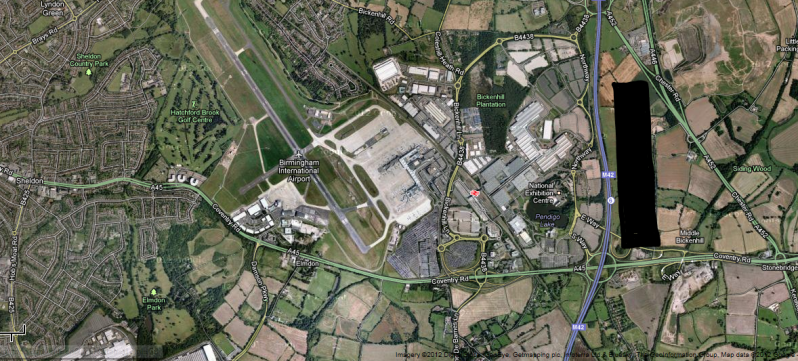
Of course such a route is not possible until the runway is extended. That process is now under way – the main A45 road is being diverted - for an opening in 2014. Between now and then expect more contact between Birmingham and airlines in China, also in Japan. There is a master plan that includes a 2 km second runway which can be brought into play quickly if the government were suddenly to come down on the side of Birmingham for dramatic expansion but otherwise there is no need for one until around 2030 on current projections. The airport has the force of law behind it on this issue. The second runway was agreed to in principle in the Nov-2003 Aviation White Paper ‘The Future of Air Transport’, which remains in effect because of the present government’s abject failure to move swiftly towards a new national aviation (better still, transport) strategy.
Lack of air service is actually a USP
...if you see an aircraft moving please tell us”,...
Ironically though, for all the route development activity, one of the strongest messages Birmingham can ram home to visiting politicians – there have been many these last couple of years and it often does this – is to ask them light-heartedly “if you see an aircraft moving please tell us”, as if to emphasise the lack of utilisation of a largely sunk cost facility. The management then asks the politicians to go away and do their own research rather than rely on what BAA and the ‘old guard’ tells them, a policy that appears to be paying dividends.
One of the key issues facing the management has been the change of ownership that took place in 2007 and around the time of enforced changes at senior management level as well, following a tragic road accident that claimed the life of the then CEO, Richard Heard. In the wake of that event Finance Director Joe Kelly took temporary charge until the appointment of Paul Kehoe in Jul-2008 whereupon he took the Deputy CEO role.
Birmingham had been under the joint ownership of (a) the seven West Midlands local metropolitan borough authorities representing the public sector; (b) Dublin Airport Authority (DAA) as another public sector investor/operator; and (c) Australia’s Macquarie Airports (later MAp Airports). During 2007 the shares owned by DAA and MAp were sold to Canada’s OTPP and Australia’s Victoria Funds Management (VFM) (48% of the total), leaving the public sector with marginal overall control. Both OTPP and VFM are pension fund managers that look to the long-term in their investment profile, unlike most typical private sector investors.
It appears that both OTPP and VFM have a ‘hands-off’ approach to day-to-day management whilst at the same time ensuring they are well represented at board meetings and especially where financial data and traffic projections are under discussion.
But it is what happened during the previous regime that is interesting, and perhaps indicative of how external public/private sector investors do not always work too well together. Although the evidence is only anecdotal it appears that there was a lack of any sort of viable business plan for many years, during which time the marketing and route development department (to take just one example) mushroomed to 13 staff members. There is a feeling that the airport was there to be milked and that there was no desire to draw up a viable framework for future growth.
Ultimately, the change of ownership took place and, as is often the case in these situations, the management felt it necessary to have a complete clear out of personnel.
One of the ways in which the new spirit at Birmingham can be gauged is within the marketing function, in the appointment of a new ‘Head of Brand’, Jo Lloyd, who arrived at Birmingham from a background not so much in the airports business (although she has worked at Luton Airport, where Mr Kehoe was once CEO) but in tourism development with companies like Centre Parcs, Crystal Holidays (ski-ing) and TUI. Ms Lloyd now has almost sole responsibility for marketing, the route development department having been hived off to another newcomer.
Goodbye ‘International’, Hello World
More than 400 staff members have been through the programme to date and they are encouraged to apply ‘peer pressure’ to each other to ensure that attitudes are not merely changed, but reinforced.
One of the first things Ms Lloyd did was to remove the ‘International’ from Birmingham International Airport on the basis that it was not needed and that it would be easy to confuse Birmingham with other airports that refer to themselves as ‘international’ when they patently are not. Bright colours replaced not-so-bright ones and the message ‘Hello World’ in a large friendly type face appeared on various buildings. Probably the most important measure was to introduce a customer service programme in conjunction with the Human Resources department. More than 400 staff members have been through the programme to date and they are encouraged to apply ‘peer pressure’ to each other to ensure that attitudes are not merely changed, but reinforced.
Just to prove that there is a tough side to the new Birmingham airport as well as touchy-feely one, a new and by all accounts ‘edgy’ marketing campaign is about to be launched that will promote Birmingham’s attributes at the expense of rival airports in a political-style ‘knocking’ agenda. The gloves are off.
Birmingham’s planning department is probably as busy as it ever has been right now, not only with the runway extension but also with land use issues that arise from it and the eventual arrival of the HS2 rail line and station. HS2 was actually left out of the Queen’s Speech that opened Parliament in May-2012 but it is a hybrid bill under two separate Acts of Parliament and the intention is that, subject to the inevitable cascade of objections that will emanate from individuals and pressure groups at certain parts of the route between Birmingham and London, it will proceed through the legislative process during this Parliamentary session.
One issue that is being considered is what use can be made of a relatively low grade piece of green belt land called the Meriden Gap...
Birmingham’s master plan, to 2030, comes up for review every five years but with the runway extension, which was only agreed last year, and the HS2 project, it is being overtaken by events. One issue that is being considered is what use can be made of a relatively low grade piece of green belt land called the Meriden Gap, just to the east of the M42 motorway and within a mile or so of the airport.
Airport City potential
This piece of land has been earmarked for the HS2 station for the airport (the contemporary one would also remain for slower trains), and other spare land nearby – including a landfill site - could be employed as the home of an airport city of sorts. Birmingham Airport is aware of the publicity coup achieved by Manchester Airport in announcing its own airport city, the first in the country, and one that will offer much improved employment prospects on nearby municipal housing estates. Such economic generators are proven air traffic generators. Birmingham could do much the same for its own Marston Green estate, which suffers from high unemployment levels, whilst at the same time offering speculators the opportunity to renovate existing run down apartments into ‘executive ones’ to service management needs in the new ‘city’. The problem remains of course that it is green belt land, irrespective of the ‘quality’. There will always be objections.
The realignment of the A45 road in preparation for the runway extension, referred to earlier, is interesting because there is only a small financial contribution from the airport, of GBP7 million. The Department for Transport was convinced the procedure has a Return on Investment in its own right, and there was no enquiry or judicial review. One of the difficulties in planning for a second runway that may not be required for a couple of decades is anticipating what the expansion plans of the nearby Land Rover (motor vehicle) car plant are likely to be. At least the improvement to the trunk A45 road, which provides access to and from a plethora of motorways running through the region, will go down well with the management there.
Another way in which Birmingham is bucking the trend of the typical regional airport may be found in the way it has married the activities of the ‘environment’ and ‘community’ departments.
The airport is very proactive where environmental matters are concerned, having installed solar power panels on the terminal roof. It pays to be, as the local Member of Parliament for the Meriden constituency, Caroline Spellman, is currently Secretary of State for Environment, Food and Rural Affairs.
Making noise about noise
Most airports can confirm that this variety of village at one and the same time harbours the most frequent flyers and the loudest protestors about aircraft noise.
While all the talk until the recession set in was of aircraft emissions (whatever happened to the pressure group ‘Plane Stupid’?) Birmingham’s Environment Manager Kirstin Kane and her colleagues point out that noise remains the priority at Birmingham (in fact it never went away), because of the proximity of the Marston Green estate at one end of the runway and of Upper Middle Class/retirement villages such as Hampton-in-Arden and Catherine-de-Barnes at the other. Most airports can confirm that this variety of village at one and the same time harbours the most frequent flyers and the loudest protestors about aircraft noise.
The majority of complaints are about off-track departures, and occasionally arrivals, and the airport has worked to reduce these from 700 to 350 per annum. The way in which Birmingham is a little different is that it is very proactive in the community by regular contact with ‘educators’, whom it keeps up to date on noise developments so they can pass the message on accordingly within their communities. These activities are supported by selective sponsorship of local community events, so that inhabitants come to associate the airport with a positive rather than negative image. People considering moving to the area (the villages are much sought after places to live in and property prices are high) are encouraged to look at flight paths on line through a facility offered by the airport, and learn how they can complain if necessary.
Upwards of 7000 properties have already been insulated with double glazing at an average cost of GBP3000. The airport itself contributes GBP75000 annually to a Trust Fund, adding in the fines levied on airlines for breeching track regulations.
From Play School to Flight School
One of the most impressive community campaigns is ‘Flight School’, also partly financed out of the Trust Fund, and which, apart from an educational role, also helps prepare young people in the locality for future employment at the airport. Debates have been held recently on subjects such as HS2 and the proposed Thames Estuary airport near London, dubbed ‘Boris Island’.
On a more pragmatic level there are both aircraft run-off (e.g. de-icing) and bird problems to contend with. There are two water courses running through the airport estate and the runway extension will have to take them into account. Overall the community wants the airport to be developed as soon as possible (employment prospects beat noise concern every time) but there is an issue locally about the culling of birds.
Congestion around airports is a matter of environmental concern and Birmingham’s target is for 25% of staff and customer access/egress to be by public transport or other non-car means by 2012, and 37% by 2020. This is an ambitious set of targets because despite the location of the rail line and station, road access is as good as it is anywhere in the UK. Car sharing schemes are promoted with priority on parking given to those who sign up and bike lanes have been introduced (though that method of getting there is still just 2% of the total journeys). The management introduced an innovative and co-operative approach to cutting down on unnecessary journeys made by freight operators by agreement with those firms.
Policemen making waves
In the field of energy use management old terminal facilities are being retrofitted with more environmentally friendly features but the more interesting investigation just now is into how road humps (or ‘sleeping policemen’ as they are also known) that are designed to slow down traffic might also generate power in the same way as sea waves do.
Responding to the recent interest in bio-fuels, a Dutch company can now supply such fuel at Birmingham. The first flight in the UK operated solely with bio-fuel, by Thomson Airways, took place out of Birmingham in Sep-2011.
Such a pro-active airport might be in demand abroad, to offer management solutions, but according to Paul Kehoe while it is a case of never say never, Birmingham would only consider temporary management assignments rather than involve itself in ‘group’ activities just now. One of its investors, OTPP, itself has interests in five airports presently, and that might be a way in which Birmingham could offer its own expertise elsewhere. Copenhagen Airport, another OTPP investment, used to be very active in airport and management in its own right and still owns 49% of the UK’s Newcastle Airport.
In summary, while Birmingham Airport still has to contend with the baggage left by the changing economic landscape of the UK, it has a number of things going for it:
•Ambition, confidence and the loquaciousness to get its message across;
•Creativity and invention across the workforce;
•HS2;
•A solid heritage industrial base waiting to be revived and, at last, some new industries;
•Widening of its catchment area into wealthier regions;
•A potential breakthrough with one or more of Emirates and Chinese airlines that would put it firmly on the global map;
•An all-eventualities master plan already in place;
•Environmental/community affairs pro-activity;
•Potential airport city.
In the short term Birmingham could prove its mettle so to speak by handling Olympic Games traffic. The city has been selected by the Americans, amongst others, as their training base. But that is unlikely to happen as the government is pushing Heathrow, the designated ‘Olympics Airport’ to handle as much air traffic as possible. The severe shortage of Border Agency (Immigration) staff at Heathrow and Stansted airports might indicate on the face of it that Birmingham could prosper out of those shortages but the fear is that the (national) Border force personnel in London would be supplemented from places like Birmingham.
The case is made and it deserves a hearing
The fly in the ointment, as ever is the case, is the government. On 10-May-2012 the Secretary of State for Transport, Justine Greening said there is “cross party agreement that a third runway at London Heathrow is not an option” and the Government is not in favour of mixed use of the parallel runways either. Just 11 days later, her Transport Minister, Theresa Villiers, confirmed the Government will consider evidence about a third runway for Heathrow Airport. She stated the Government is officially opposed to a third runway, but will consider all options during the upcoming consultation on aviation policy. (Previously the government had said repeatedly it would consider all options except a third Heathrow runway). Ms Villiers also said a second trial of dual-use of the Heathrow runways – where each runway is used for both take off and landing – would run for nine months from Jul-2012.
Birmingham has made a very strong case to take a far more significant role in air transport in the UK...
When the government’s left hand does not know what the right hand is doing no amount of planning and promotional work by an airport is guaranteed to produce a result. But Birmingham has made a very strong case to take a far more significant role in air transport in the UK, it has got the ear of government at least and it deserves to be heard.