Little headway on Leeds Bradford Airport parkway station
A rail link to Leeds Bradford Airport remains a distant proposition. ANDREW MOURANT reports on the lack of tangible progress.
Few infrastructure projects make better sense than improving public transport to busy airports.
Doing so to those of Bristol, Glasgow, and Leeds/Bradford - all stuck out on a limb without a rail link - has long been a hot topic of debate.
At least the latter has one thing in its favour: its location close to the Leeds/Harrogate line.
The A65 north-west of Leeds is forever clogged up with commuter traffic and that of air travellers. Plans first announced in 2016 by West Yorkshire Combined Authority (WYCA) to create a Leeds Bradford Airport (LBA) parkway station north of Horsforth therefore made perfect sense.
These were shaped against a backdrop of over four million passengers travelling through LBA in 2018, with forecasts that this number would double by 2050.
WYCA was bullish about the concept. “A transformational step change for public transport,” it declared.
Alas, no such transformation has taken place - and there are no guarantees that it ever will.
Five years ago, there appeared to be a road map pointing to LBA Parkway opening in 2024, but now all is shrouded in doubt. There have been barely any public updates, and smatterings of public information shed little light.
In 2023, with nothing visible having happened, WYCA emerged from its shell, stating: “The scheme is currently progressing a full business case, with the aim to submit to our assurance team by the end of the year. Subject to approvals, further detailed design will take place and planning application will be sought in 2024, with the delivery phase starting after.”
Another two years of silence followed until, in July this year, WYCA issued the following update: “The scheme is… going through an assessment of deliverability and affordability in response to rising costs for project delivery. We’ll have a clearer understanding of the timeline for our next steps upon completion of this activity.”
This smacks of a scheme that has stalled and may yet wither on the vine. But why? RAIL resorted to the Freedom of Information (FoI) Act seeking answers.
The issue of whether or not the station gets built preoccupies many local air travellers, and matters greatly to LBA Chief Executive Vincent Hodder.
In February 2020, an Outline Business Case for the station was discussed at a WYCA meeting. Then, the estimated cost was £41.98 million.
As the scheme’s promoter, WYCA was seeking £4.5m from Leeds Public Transport Improvement Programme (LPTIP) for land acquisition (£2.7m), with the rest earmarked for developing a full business case. The station’s Cost:Benefit Ratio (CBR) was calculated at 4.3:1 - “very high value for money”, according to Department for Transport criteria.
And the latest cost estimate? WYCA told RAIL this is now between £50.3m and £67.5m, based on the initial findings of “a minimum viable product exercise” undertaken by Network Rail.
So, much uncertainty remains about the final bill, with those variables being “confirmation of the scope and design, stakeholder requirements, and the findings of ground surveys on land outside the authority’s ownership”.
To date, almost £5m (£4,950,500 to be precise) of LPTIP funding has been spent on aspects such as land purchase, along with £592,250 of West Yorkshire-plus Transport Fund money on taking the scheme to ES4 stage (design standards approved and approval in principle). But the business case development being worked on in 2023 remains a work in progress.
In 2020, WYCA leaned towards the option of a station with a 350-space car park, shuttle bus connection to the airport terminal, and 1.2km of new highway links.
The principal stumbling blocks were: affordability, with only £5m of the £42m estimate funded; capacity issues on the Harrogate line that might supress demand for rail travel in the corridor; and difficulties getting planning permission for a park and ride site in the Green Belt.
The Cost:Benefit Ratio, about which WYCA was so chipper in 2020, no longer holds good five years later.
CBR for the station is yet to be reviewed,” WYCA admits.
“This will be re-run… responding to the final outcomes of the minimum viable product exercise.”
WYCA blames the high price (whatever that turns out to be) of delivering LBA Parkway on “rising rail industry costs, technical site constraints, and inflationary increases more generally”.
Meanwhile, the current exercise in assessing deliverability and affordability is destined to grind on until summer 2026.
In June this year, LBA opened a £100m terminal extension, increasing space for passengers by 40% and adding three boarding gates.
These improvements were much needed, given that 2024 saw a 5.8% rise in users compared with 2023, with 4.24 million people taking almost 32,000 flights.
Work is now under way to refurbish the existing terminal. By late August 2025 (the busiest single month in LBA’s history), the airport had already welcomed over three million flyers.
Hodder is in regular contact with the CEOs of Bradford and Leeds City Councils, both members of WYCA. There has been much talk of developing a business zone on land near the station site owned by both councils.
“A new station is an element of that strategy, and also makes it easier to get to the airport from distances further away,” he says.
Ed Whiting is obsessed with delivering this station. It doesn’t need to be an architectural marvel… we’re not looking for the Taj Mahal.”
As LBA has undergone expansion, Hodder has built up a network of construction and architect contacts. It has led him to question the costs cited by WYCA.
“I had a conversation with one of our contractors who builds stations for NR all the time, and who reckons we could build one and get significant change out of £30m,” he says.
He also believes WYCA is taking fundamentally the wrong approach.
“They should start by saying how much is the benefit, and then ask: ‘what is the maximum amount we can pay to make it make sense?’”
Hodder has “concrete ideas” around a different way to approach building the station, but is reluctant to be drawn further as these are “still in the early stages of feasibility”.
The plans remain for two trains per hour to serve the airport station. Capacity issues raised by WYCA five years ago remain. There are constraints on the slow track between Harrogate and Leeds.
“But you can speed up the line, according to Network Rail. That would cost single-digit millions,” says Hodder.
Part of the price, however, might be to drop some stops at small stations such as Starbeck, Pannal or Hornbeam Park.
He doesn’t think overcrowding would become a problem: “Rush hour and peak airport user numbers don’t overlap - the latter would be earlier in the morning and afternoon.”
So far, no demand for night-time services has been factored in, although Hodder brushes that aside.
“If we get the station built, we may be able to slip those in later,” he says.
Many with Yorkshire pride find it galling that there’s a direct rail link from Leeds city centre to Manchester Airport, but not to the one on its doorstep.
“We very much support the new station - connectivity is a huge issue in West Yorkshire,” says Mark Casci, head of representation and policy for West and North Yorkshire Chamber of Commerce.
While LBA has the reputation of being largely a “bucket and spade” airport for holidaymakers, the chamber is trying to stimulate interest in longer-haul routes - for example, to cater for “the huge diaspora” from South Asia. The runway could cope easily with larger aircraft.
The chamber is raising this at trade missions abroad - for example, in the US. And it expects to do so again in Saudi Arabia and Bahrain later this year.
Casci thinks LBA lags behind Manchester in part owing to its legacy of co-ownership by five local metropolitan councils. He believes the terminal expansion might start to address its image problem and improve public perceptions.
As for LBA Parkway, what does he make of its painfully slow grind through WYCA?
“I think airports struggle to attract political support because of concerns over emissions,” he says.
“But sustainable aviation will come - we need to look at it in the long term. You can’t go back to the steam age.”
And yet it’s not impossible that WYCA might scrap LBA Parkway altogether.
“As with all projects… delivery is subject to receiving consents and approvals, including approval of the full business case,” the authority says.
“Decisions… must also consider affordability in the context of the wider capital programme and regional priorities, and the finite funding available.”
The scheme in detail
The roads of north-west Leeds are congested (especially at peak hours) and are mainly single carriageway.
“Improved highway access solely provided by a link road is not a long-term sustainable solution,” West Yorkshire Combined Authority said back in 2020.
“It is also of paramount importance that … there’s sufficient access to the rail network so more people can reach Leeds city centre
A new direct rail link to the terminal was always going to be too costly, so the alternative was guided by the 2016 feasibility study carried out by civil engineers Atkins.
This concluded that the only realistic site lay between Horsforth and the southern portal of the Bramhope Tunnel. Although presenting topographical and highway access problems, anywhere north of the tunnel would be more remote, both from the airport and population centres.
The plan was (and remains) for a shuttle bus service to the airport from LBA Parkway. There would be two trains per hour, one serving passengers travelling to and from Knaresborough and York.
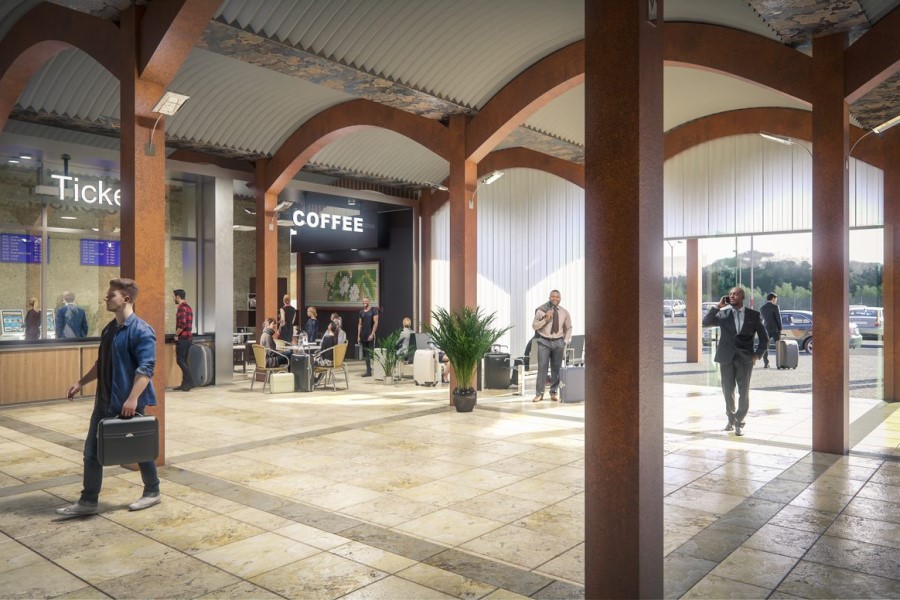
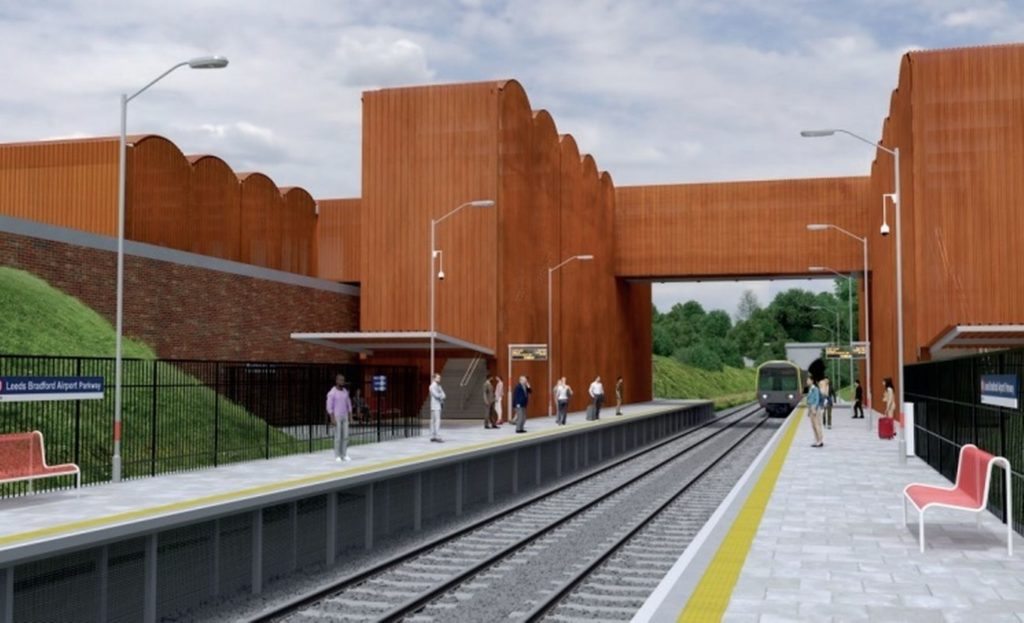
The new station would have two platforms with waiting rooms. Platform access would be via covered stairways or lifts, as (given the site’s topography) platforms would sit below the station building.
An overbridge would give cross-platform access and lead to a pedestrian and cycle access route to the residential area of Cookridge. A new spur road would connect the station to Scotland Lane.
The full business case was to have been made by 2021, construction started in May 2022, and the station completed by April 2024 - a timeline based on “current assumptions, and subject to available funding, obtaining the necessary consents and approvals, and land assembly.”
For reasons best known to itself, many details of WYCA’s plans were kept secret. Its report of six years ago is peppered with baffling redactions.
Cost estimates for the station were produced by Faithful & Gould, a subsidiary of Atkins, using “industry rates, standard GRIP process allowances, and outturn costs from recent new station schemes”.
Commercial and management issues - “adequately presented but constrained” - were to be considered “indicative”.
Secrecy surrounded such matters as: the predicted price of construction works; assumed overheads and profit; cashflow; project; land assembly and procurement costs; contingency; surveys; and the likely cost of inflation.
WYCA said the scheme would be expected to yield “a small surplus” over its first three years of operation, but gave no hint of what that might be.
Passenger demand calculations were also blanked out, although the report concluded that airport traffic would account for 40% of total demand at LBA Parkway.
Even estimated rail journey times were redacted, too. The report did, however, declare that “large journey time savings” would accrue for new users.
One option mulled over five years ago was for WYCA to enter into a design and build contract with Network Rail. WYCA also contemplated seeking significant third-party investment.
This could see delivery, and the associated risks transfer… with WYCA to retain responsibility for the workstream and leading on delivering a timetable.”
With only £5 million of the projected £41m cost in place, the big hurdle was finding the rest.
WYCA hoped that the prospect of fares exceeding operating costs might open avenues, and that there could be the potential to borrow against future revenue - for example, from car parking. Also floated was the idea of seeking money from Leeds Bradford Airport.
As “funder of last resort”, the authority would have to cover any cost overrun, so it wasn’t hard to see the appeal of offloading some of the delivery risk.
But WYCA’s recent record of joint ventures isn’t a happy one, as the non-completion of White Rose station in south-west Leeds illustrates only too well.